
Congressional Debate: Understanding the Scholastic Legislative Event
Overview of Congressional Debate
Congressional debate – sometimes called Student Congress or legislative debate – is a competitive high‑school speech and debate event that simulates a session of the U.S. Congress. Students draft and submit bills or resolutions and then meet in a chamber to debate and vote on those proposals. The National Speech & Debate Association (NSDA) describes the event as a simulation of the U.S. legislative process in the House and Senate. Students generate bills and resolutions in advance and alternate delivering speeches for and against the topic in a group setting. Participants are evaluated on research, argumentation and delivery skills as well as their knowledge of parliamentary procedure. The event requires competitors to form opinions on current events and learn the legislative process while using persuasive communication, making it a popular format for students interested in lawmaking and public policy.
Key Points: Congressional debate is a group debate format modeled after the U.S. Congress
Students debate bills and resolutions, not fixed sides
Speeches are typically three minutes, followed by questioning
Debate follows parliamentary procedure, including motions and voting
Participants are evaluated on research, argumentation, delivery, and leadership
Practiced mainly in U.S. high schools, but adapted globally as youth parliaments
How Congressional Debate Works
Legislation and dockets
The heart of congressional debate is the legislation. Students submit bills (proposals that would become law) or resolutions (statements expressing a position) to tournaments. NSDA guidelines require that the legislation be national in scope and within the jurisdiction of the federal government of the United States. Bills enumerate specific provisions with the force of law, whereas resolutions express convictions or recommendations; constitutional amendments are treated as resolutions. Tournament officials compile all submissions into a docket, which is distributed to participating schools ahead of time so students can research and prepare.
Chambers and sessions
At tournaments, competitors are divided into chambers of roughly 10‑25 students (the NSDA recommends 18). Each phase of the event is a session, which is essentially a mini‑parliamentary meeting. A session should last at least three hours, with 18–20 students as the optimum number; if the chamber is larger, organizers should add ten minutes per additional student. Each session includes the election of a presiding officer, a new seating chart, resetting of speaker precedence/recency and debate on fresh legislation. Students stay in the same chamber for the entire session and may advance to elimination rounds at larger tournaments.
Presiding officer and parliamentary procedure
Before debate begins, the chamber elects a presiding officer (PO). The PO is responsible for facilitating fair, balanced and efficient debate by recognizing speakers, questioners and motions. The PO must follow parliamentary procedure based on Robert’s Rules of Order and the NSDA unified manual. When multiple students seek the floor, the presiding officer uses precedence (speakers who have spoken the fewest times) and recency (those who spoke least recently) to decide whom to recognize.
Speeches and questioning
Debate begins with an authorship (or sponsorship) speech, a constructive speech of up to three minutes given by the student whose school submitted the legislation. This speech introduces the bill or resolution and is followed by a two‑minute questioning period. The opposing side responds with the first negative speech, also three minutes with a two‑minute questioning period. After these initial speeches, affirmative and negative speakers alternate; each speech lasts up to three minutes and is followed by one minute of questioning. The NSDA unified manual echoes this structure, specifying that speeches introducing legislation be allotted up to three minutes followed by two minutes of questioning, while subsequent speeches alternate pro and con with three minutes of speaking and one minute of questioning.
Questioning is integral. In competitive leagues like the NCFL, cross‑examination periods are mandatory – two minutes for each of the first two speeches and one minute thereafter – and may not be suspended or expanded. Presiding officers should rule out-of-order any prefaced or irrelevant questions.
Motions and voting
Congressional debate uses motions drawn from parliamentary procedure. After debate on a piece of legislation becomes repetitive, a member may move the previous question to close debate and proceed to voting. The motion requires a second and a two‑thirds vote of the chamber. Amendments are allowed but must be germane to the legislation and submitted in writing; the PO determines whether an amendment is in order. Voting is typically conducted by standing vote, and two full cycles of speeches must occur before a vote may be taken.
Where It’s Practiced
Congressional debate is widely practiced across the United States. Major national organizations such as the National Speech & Debate Association (NSDA) and the National Catholic Forensic League (NCFL) host congressional debate events at their national tournaments. Numerous state associations and invitational tournaments also offer the event, making it one of the most accessible debate formats for high‑school students.
Some states have robust student congress traditions; for example, the Arkansas Communication & Theatre Arts Association describes congressional debate as a simulation of the U.S. legislature where a group of 10–25 students debate bills and resolutions and a student presiding officer ensures the session runs smoothly. The association notes that sessions typically last 2–3 hours, with three‑minute speeches and questioning periods. Other states, such as California (via CHSSA) and Florida (through various forensics leagues), run their own student congress competitions that adhere to unified rules but may have minor variations.
Although the event is most popular in the United States, similar parliamentary simulations exist worldwide.
In the United States, the format is commonly called student congress
In other countries, it may be referred to as:
- Youth parliament
- Legislative assembly
- Youth parliamentary debate
These formats are designed to mirror the legislative process of participants’ own communities.
Legislative debate formats can be divided into two broad models:
- Competitive congresses, which:
- Rank speakers
- Emphasize debate skills and argument quality
- Focus on individual performance and evaluation
- Non-competitive congresses, which:
- Prioritize cooperation and collaboration
- Encourage consensus-building
- Allow participants to champion real-world solutions alongside governmental or non-governmental organizations
In Canada, this format is often known as Youth Parliament
In the United Kingdom, youth parliamentary debates offer a similar structure for proposing, debating, and voting on policies
Many students also develop parliamentary skills through related programs such as:
- Model United Nations
- Youth parliaments
These programs share structural similarities with congressional debate, including:
- Formal procedures
- Structured debate
- Motions and voting
How Students and Coaches Use Congressional Debate
Research and preparation
Success in congressional debate begins long before the session. Students must research each bill or resolution in the docket thoroughly and prepare arguments on both sides. Competitors should always review tournament procedures, obtain copies of bills and resolutions, and investigate sources of information such as libraries, the internet and experts. This is where organizing research into outlines supporting both the affirmative and negative sides and considering potential questions for cross‑examination is very beneficial. Because students may be called unexpectedly to speak on either side of a bill, wise competitors develop arguments and counterarguments for each piece of legislation.
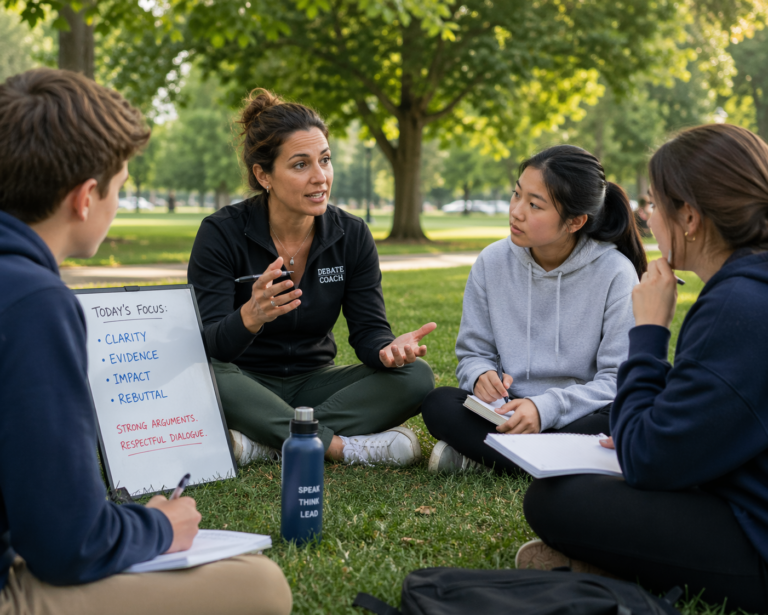
Coaches play a crucial role in this preparation. They often guide students in selecting research sources, crafting legislative proposals and writing speeches that follow the claim‑data‑warrant‑impact structure recommended by the NSDA’s Start Here curriculum.
Developing leadership and collaboration
Beyond research, congressional debate teaches leadership and collaboration. Participants elect a presiding officer and must work together to manage the docket, debate schedule and voting procedures. Students work well with peers to serve as advocates for their “constituents” and to pass meaningful legislation. The competitive model fosters individual excellence: participants are judged on their ability to advocate solutions, develop strong arguments and generate support.
Skill development
Congressional debate cultivates a wide range of skills. The event demands public speaking and argumentation; speakers must craft compelling introductions, organize logical contentions and deliver clear conclusions with limited preparation time. Students learn to anticipate and answer questions succinctly under time pressure, building quick thinking and responsiveness. Congressional debate rewards students who are analytical, persuasive and engaged with current issues, and that the event is an exercise in leadership where taking risks and being active participants are essential for success.
By emulating real legislators, students gain familiarity with parliamentary procedure, motions and voting rules, which demystifies how democratic institutions operate. Student congress participation fosters critical thinking, cultural learning and respect for other viewpoints. Participants develop empathy by negotiating differences and seeking consensus, and they learn to see themselves as knowledgeable citizens capable of contributing to political dialogue.
A Last Word on Congressional Debate
Congressional debate combines the intellectual rigor of competitive debate with the collaborative spirit of legislative deliberation. It challenges students to research complex policy issues, write and amend legislation, master parliamentary procedure and deliver persuasive speeches under pressure. Through chambers, presiding officers, precedence and cross‑examination, the event mirrors the workings of democratic institutions and instills respect for civic processes.
Debate FAQ:
Congressional debate is a competitive high-school debate format that simulates the U.S. legislative process. Students act as members of Congress, debating bills and resolutions in a chamber using parliamentary procedure, structured speeches, questioning, and voting.
In congressional debate, students prepare legislation in advance and debate it in sessions lasting two to three hours. Speakers give timed speeches for and against each bill, answer questions, follow precedence and recency rules, and vote on whether the legislation passes.
Students develop public speaking, research, critical thinking, leadership, and collaboration skills. Congressional debate also teaches parliamentary procedure, civic literacy, and how democratic institutions function in practice.